
Search for how a dog harness should fit and you will receive, roughly forty times over, the same sentence: you should be able to slide two fingers under the strap. It is repeated with the confidence of scripture and the specificity of a horoscope. It is also, taken alone, close to useless, because it answers the question how tight while quietly skipping the two that actually matter: tight where, and pressing on what.
A harness is not a decorative loop. It is a load-transfer device. Every time your dog moves toward something interesting, the force of that intention travels down a lead, into a piece of leather or webbing, and out into a body. Where that force lands is the entire design problem. Land it correctly and the dog forgets it is wearing anything. Land it badly and you have built a machine for producing a shortened stride, a bald patch under the front leg, and a dog that has quietly concluded that walks are something to be endured.
So before the rule, the anatomy.
What Is Underneath
There are four structures under a harness that determine whether it is a good one. None of them appear in the average size chart.
The Shoulder Blade
The scapula, and the reason harness design is harder than it looks
Here is the fact that reframes the whole category. A dog has no functional collarbone. In you, the clavicle bolts the shoulder to the skeleton; in a dog it is vestigial, and the shoulder blade is suspended in muscle instead. It is not hinged to anything. It slides.
That sliding is the dog's stride. Every step, the scapula rotates and travels across the ribcage, and the length of that travel is the length of the step. Lay a strap across it and you have not made the dog uncomfortable in some vague way. You have physically shortened its stride, on every walk, for as long as it wears the thing. The dog will not limp and will not complain. It will simply take smaller steps, and you will never connect the two.
Stand behind your dog and watch it walk away from you. The front legs should reach the same distance they do with nothing on. If the harness is on the shoulder blade, they will not, and you will see it within ten steps once you know to look.
The Armpit
The axilla: thin skin, no fur to speak of, and a nerve bundle beneath
If a harness is going to fail, it fails here. The skin in the armpit is thinner than anywhere else the harness touches, sparsely furred, folded, and in constant motion. Underneath it runs the brachial plexus, the nerve bundle serving the entire front leg, sitting closer to the surface than most owners would guess.
The counter-intuitive part: chafing here is usually caused by a harness that is too loose, not too tight. A loose harness migrates. It slides forward on the walk, works its way into the fold, and then saws gently for forty minutes. Owners feel the strap, decide there is plenty of room, and never suspect it. Meanwhile the answer to almost every armpit complaint in this category is a strap positioned two fingers clear of the fold and tensioned properly enough to stay there.
Lift the front leg and look. Pink skin, parted hair, a faint line: that harness is moving. It is not too tight. It is not staying where it was put.
The Sternum and Ribcage
The only structures on a dog built to take the force
Now the good news. The breastbone is a solid plate of bone at the front of the chest, and the ribcage behind it is a hoop of bone wrapped in muscle. Between them they are the one place on a dog engineered to absorb and spread load. This is where a lead's force is supposed to arrive.
Here is the part that confuses people. On a Perro Collection harness the lead attaches to the D-ring on the back, between the shoulder blades. So how does the force reach the chest? Because the harness is a single structure. When your dog pulls, tension arrives at the back ring and travels forward through the body of the harness into the strap across the sternum and the band around the ribcage. The ring is where the lead is held. The chest is where the load lands.
Which means the front strap must sit flat and level across the sternum, not riding up the throat and not sagging toward the paws, and the band behind it must sit around the ribcage, over bone, well forward of the last rib. Get those two right and the dog can pull with everything it has and nothing is under strain.
The small ring at the chest is for the hangtag. It is not a lead attachment and is not rated as one. The lead goes on the back ring, on both the step-in harness and the H-harness. This is worth knowing before you discover it the hard way.
The Throat
The trachea, and why the lead moved off the collar in the first place
The windpipe runs down the front of the neck under very little protection: a tube of cartilage rings and soft tissue, immediately beneath the skin. It is the single most exposed structure on the walking route, and it is the whole argument for the harness as an object.
When a dog lunges on a lead attached to a collar, the full force concentrates on that tube. This is not a theoretical concern for enthusiastic dogs, and it is a serious one for the flat-faced breeds and the fine-necked sighthounds. A harness exists to move that force from a cartilage tube onto a plate of bone. A harness whose neck loop has crept up onto the throat has undone the only thing it was built to do.
The neck loop sits at the base of the neck, where the neck meets the shoulders, not up under the jaw. If your dog swallows and you can feel it against the strap, the strap is too high.
A dog does not tell you the harness is wrong. It takes smaller steps and hopes you notice.
Two Fingers, Where
Now the rule is worth something, because you know what it is protecting.
Two fingers, flat, under every strap, checked independently. Not one representative spot. Not the strap that happens to be easiest to reach. The neck loop, the chest strap and the belly band are three separate systems and they can each be wrong on their own.
And scale it to the dog. On a very small dog with narrow straps, two fingers is a physical impossibility and one is the honest check. On a large dog with wide straps, three fingers may be closer to correct. The number was always a proxy. What you are really testing is: does this strap stay exactly where I put it when the dog moves, and does it press on nothing that objects.
Two conditions, both required:
It does not move. Take the harness in your hand and try to rotate it. It should resist. A harness that turns on the body is a harness that will walk itself into the armpit within ten minutes.
It does not restrict. Then walk the dog and watch, from behind and from the side. Full stride, free shoulders, no hitch, no shortened reach. A harness can pass the finger test and still be wrong, because the finger test is static and your dog is not.
Chest girth at the widest point, immediately behind the front legs, dog standing on all four legs. Never size by weight. Two dogs at fifteen kilograms can differ by four to six centimetres of chest: one is a barrel, one is a blade, and a weight chart puts them in the same box. Our size guide works from the tape, not the scale.
Step-In or H-Harness
Start with what they have in common, because it is the part the rest of the market does not.
Neither goes over the head. This is unusual enough to be worth stating twice. The conventional H-harness, as sold almost everywhere, is dropped over the dog's skull and then buckled. For a great many dogs that single motion is the whole problem: a hand approaching the face, fabric across the eyes, and a daily negotiation that never quite resolves. Our H-harness is placed around the body instead. So is the step-in, by definition. Whichever you choose, nothing passes over your dog's head, ever.
The lead goes on the back ring, on both. The D-ring between the shoulder blades is the lead attachment. The smaller ring at the chest holds the hangtag and nothing else: it is not rated for a lead and should never carry one.
Now the difference, which comes down to a single number.
The step-in harness is sized on chest circumference alone. The dog places its front paws into two openings, the harness closes over the back, and you are done. One measurement, one motion, a few seconds. It is the simplest object we make in this category, and simplicity is not a lesser virtue when you are doing something twice a day for a decade.
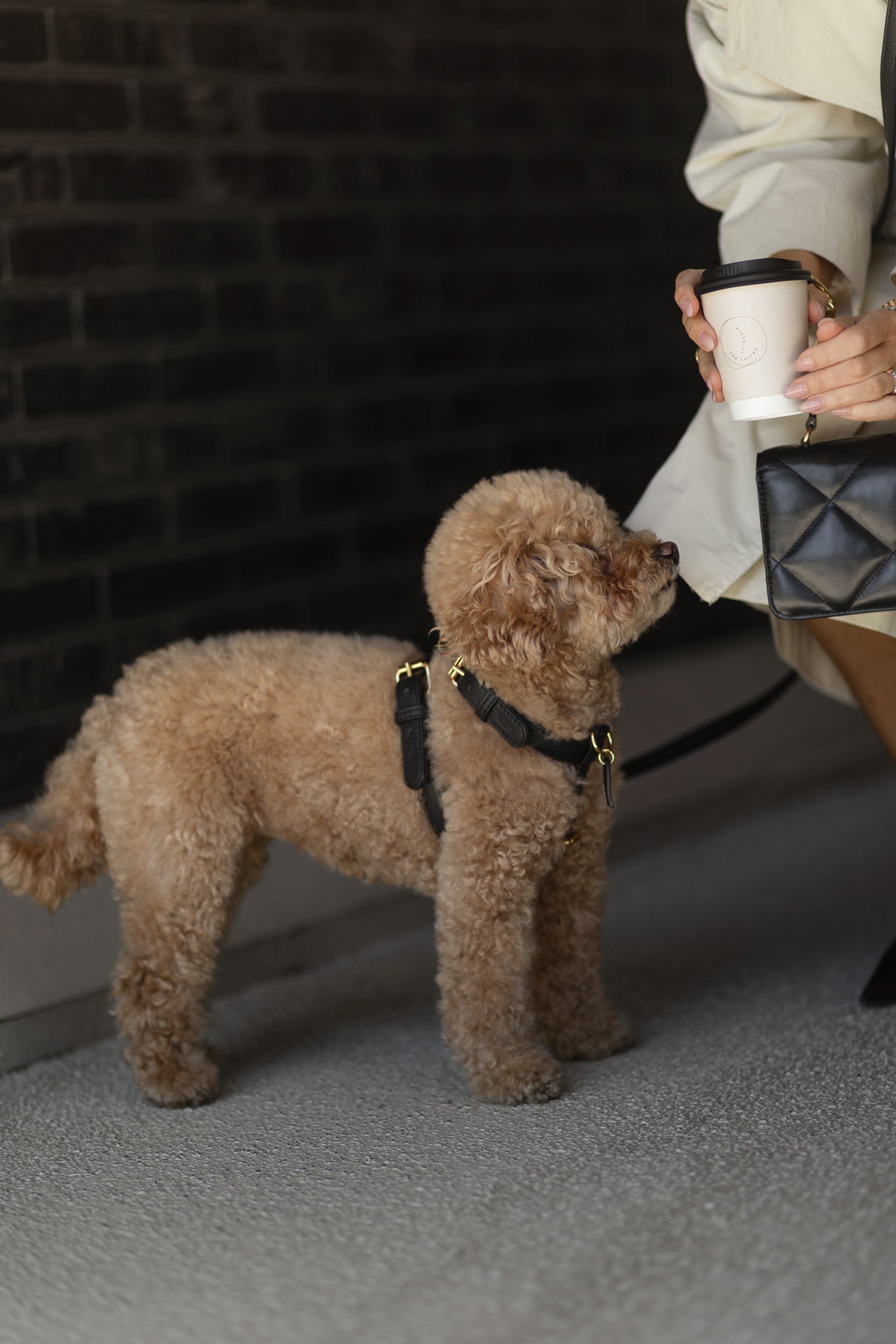
The H-harness is sized on chest circumference and neck circumference. That second measurement is the entire argument. Like the step-in, the H-harness distributes pressure across the chest, but with fewer pressure points, which is precisely what you want under a dog that puts real force into a lead. More adjustment, a more precise fit, fewer pressure points. It asks thirty seconds more of your time and gives it back in how the force is distributed. The Marrone H-Harness in natural grain leather shows the construction clearly. Which harness to choose, in which leather and in which size, is set out in our guide to the types of dog harnesses.
| Step-In Harness | H-Harness | |
|---|---|---|
| Over the head | Never | Never |
| How it goes on | Dog steps in, closes over the back | Placed around the body |
| Measure | Chest only | Chest and neck |
| Lead attaches to | Back D-ring | Back D-ring |
| Chest ring | Hangtag only | Hangtag only |
| Pressure | Evenly across the chest | Across the chest, fewer pressure points |
| Speed | Seconds | A little longer |
| Strong pullers | Workable | Preferred |
| Sizes | XXS to XXL, 25 to 69 cm chest | XXS to XXL, 27 to 65 cm chest |
| Suits | Simplicity, speed, small dogs | Power, precision, fewer pressure points |
Our Actual Sizing
Everything above is theory until you put a tape around a dog. These are our published measurements. Note that the H-harness needs two numbers and the step-in needs one, and note that the breed columns are a starting point rather than an answer: a Poodle appears at four different sizes, which is the entire reason we do not size by breed or by weight.
Step-In Harness. Chest circumference, measured at the widest point just behind the front legs, dog standing on all four legs.
| Size | Chest circumference | Width | Typical breeds |
|---|---|---|---|
| XXS | 25 to 27 cm | 1.5 cm | Chihuahua puppy, toy breeds |
| XS | 29 to 34 cm | 1.5 cm | Chihuahua, Yorkshire Terrier, Poodle |
| S | 35 to 39 cm | 1.5 to 2 cm | Pomeranian, Dachshund, Poodle |
| M | 40 to 43 cm | 2 cm | French Bulldog, Shiba Inu, Poodle, Boston Terrier |
| L | 43 to 49 cm | 2 cm | Beagle, Cocker Spaniel, Pug |
| L/XL | 49 to 52 cm | 2 cm | Border Collie, Cocker Spaniel |
| XL | 53 to 62 cm | 2 cm | French Bulldog, Dalmatian, Boston Terrier |
| XXL | 63 to 69 cm | 2 cm | French Bulldog, Goldendoodle, Pug |
H-Harness. Two measurements: neck circumference at the base of the neck where it meets the shoulders, and chest circumference at the widest point behind the front legs.
| Size | Neck | Chest | Width | Typical breeds |
|---|---|---|---|---|
| XXS | 19 to 23 cm | 27 to 32 cm | 1.5 cm | Puppy, toy |
| XS | 24 to 30 cm | 37 to 43 cm | 1.5 cm | Chihuahua, Maltese, Poodle |
| S | 27 to 33 cm | 42 to 48 cm | 1.5 to 2 cm | Schnauzer, Pomeranian, Poodle |
| M | 30 to 36 cm | 45 to 51 cm | 2 cm | French Bulldog, Poodle, Boston Terrier |
| L | 33 to 39 cm | 50 to 56 cm | 2 cm | Border Collie, Vizsla, Cocker Spaniel |
| XL | 36 to 42 cm | 55 to 61 cm | 2 cm | French Bulldog, Weimaraner, Pug |
| XXL | 40 to 45 cm | 58 to 65 cm | 2 cm | German Shepherd, French Bulldog |
Take the larger. A harness one notch large can be adjusted inward; a harness one notch small cannot be adjusted outward, and it will sit exactly where you do not want it. If your measurements fall between two sizes or land outside these ranges, talk to us before you order rather than after. Our size guide will walk you through it.
On Anti-Pull Harnesses
There is no anti-pull harness in our collection today, and the reason is a specific objection rather than a general one. Our objection is to the mechanism, not the goal.
The harnesses marketed as anti-pull almost all work by the same mechanism: cords or straps that tighten somewhere sensitive, usually the armpit, when the dog pulls. The dog stops pulling. This is presented as training. It is not. It is discomfort applied at the moment of enthusiasm, and it works precisely to the degree that it is unpleasant, which is why the versions padded enough to be humane are also the versions that do not work.
It also teaches nothing. Remove the device and the pulling returns intact, because the dog learned that a particular object hurts, not that walking beside you is worth doing. In some dogs the association goes further and attaches itself to whatever was in view when the pain arrived: another dog, a cyclist, a child. Pain-based tools have a long history of producing reactivity in animals that had none.
So the honest position. A harness can change how pulling feels, and a well-designed one can make a walk easier for both of you. What it cannot do is teach: the lesson comes from you, and we have written about the method in how to teach a dog to walk on a lead. What the harness must do is narrower and non-negotiable: make sure that when your dog pulls, and it will, the force lands on bone.
Why Leather Fits Better
This is where we have an interest, so take it with the appropriate salt. The mechanism is nonetheless real.
Leather is a fibre structure that responds to heat and pressure. Worn against a body it softens, drapes, and over some weeks takes the specific geometry of the specific dog. A leather harness at month three fits better than it did at week one. It has been learning the shape.
Synthetic webbing is dimensionally stable, which sounds like a virtue and is the problem. It presents the same edge, at the same angle, to the same patch of skin, on every walk, forever. That edge is where chafing begins, and it is why the armpit complaint is disproportionately a webbing complaint.
Two honest caveats. Leather needs maintenance: a few minutes with the leather care set, twice a year. And leather is not the right choice for a dog that swims on every walk. For everything else, it is the material that ends up fitting the dog rather than the size chart.
The Fitting Protocol
The Object That Disappears
The correct answer to how a harness should fit is not a number. It is a description of a state: the dog forgets it is wearing it.
That state has conditions. Pressure only on bone. Nothing on the shoulder blade. Nothing in the armpit. Nothing on the throat. Nothing behind the last rib. Stable enough not to travel, loose enough not to bind. And re-checked, because dogs change and straps loosen and coats grow and the fit you set in March is a different fit in August.
Two fingers is where the conversation starts. It was never supposed to be where it ends.
Explore the step-in harness collection and the H-harness collection, or measure your dog with the size guide. Handcrafted in Italy, personalised with one initial, free.
Pressure on bone. Clearance at the shoulder. Two fingers, everywhere, every time.





Leave a comment
All comments are moderated before being published.
This site is protected by hCaptcha and the hCaptcha Privacy Policy and Terms of Service apply.