
To train a dog to walk on a leash, stop the moment the leash goes tight, move on only when it is slack and reward your dog for walking beside you. Use a fixed leash of 1.3 to 1.5 metres on the back ring of a well-fitted harness. Most dogs grasp it in one to two weeks; reliability takes months.
There is no genetic instruction in any dog that says: walk at the speed of the human, on the left, without leaning. It is an entirely artificial request. We are asking an animal built to trot far faster than we walk to keep to our pace, past a landscape saturated with information it can read and we cannot, and to do this while attached to us by a strap. Framed honestly, it is a remarkable thing that any dog ever agrees.
Which is why the language around this subject is so unhelpful. Dogs are described as stubborn, dominant, badly behaved. They are none of those things. They are fast, they are curious and they have learned something perfectly logical that you taught them by accident.
This is how to leash train a dog, puppy or adult. The method is not clever, it does not work in a weekend and it asks considerably more of you than it does of your dog. A dog that will not walk on the leash at all needs a different start, and that comes first.
How to Stop a Dog Pulling on the Leash
To stop your dog pulling on the lead, or the leash, start with why a dog pulls: pulling has always worked, and a tight leash triggers a reflex to push against it. Both are mechanisms rather than character flaws, which makes them your allies.
It works. This is the whole of it. Your dog leans forward, and the walk continues in the direction of the lean. Repeat that across a few hundred walks and you have run one of the most consistent training programmes in the history of animal learning: pulling produces forward movement. It has never once failed. Your dog is not ignoring your training. Your dog has been paying very close attention to a lesson you did not know you were giving.
The opposition reflex. The second reason is physical and it catches almost everyone out. Dogs, like most animals, instinctively push back against steady pressure. Press a hand into a dog's side and it leans in. Apply steady tension to a leash and something in the dog leans forward against it. This means a tight leash is not a signal to slow down. It is a signal, at the level of reflex, to pull harder. You are holding one end of a feedback loop.
Both facts point to the same place, and the entire method fits in one sentence.
You are not teaching your dog to stop pulling. You are teaching it that a tight leash is the only thing in the world that does not work.
When Your Dog Won't Walk on the Leash at All
A dog that will not walk on the leash at all is usually new to the equipment or frightened by something on the walk. It plants its feet, turns back towards the door or will not leave the pavement. That is not pulling, and the stop-and-wait rule will not fix it.
The equipment is new. A puppy that has never worn a collar, harness or leash has no idea what is being asked. Being fastened to a person and expected to follow at their pace, in their direction, is a strange sensation, and confusion often looks like refusal.
Something about the walk is frightening. A dog you have recently rescued arrives with a history you do not know. Clip on a leash and head straight into a crowded street, and fear can surface as growling, barking or lashing out. The leash gets the blame for what the street did.
In both cases the answer is to slow down before the method begins.
Make the Leash Ordinary First
Trust first, technique second
Learn your dog's fear signals. Watch how your dog reacts in different situations, so you recognise the moment something is becoming too much and can calmly take your dog out of it before it escalates.
Teach a few basic cues at home. Sit and stay, practised indoors with a pocket full of the treats your dog likes best. Short, easy sessions that end well give you both a shared language before you step outside.
Introduce the harness and leash indoors. Put them on and walk around the house. Then move to a quiet garden and practise the same cues there. Only when the leash has become unremarkable do you try the street, and a quiet one first.
Keep every step positive. The aim at this stage is not a neat walk but a dog that has learned the leash predicts good things. If fear or reactivity persists despite this, it is a question for a qualified force-free behaviourist rather than for a training method.
How to Train a Dog to Walk on a Leash, in Four Parts
To train a dog to walk on a leash, set calm conditions, stop every time the leash goes tight, pay for the place beside you and keep short training walks apart from longer sniffing walks. Those are the four parts below.
Loose leash walking is not heel. Heel is a formal exercise: your dog held in position at your leg, on cue. This method asks for less and for something more useful on an ordinary street: a leash that hangs slack. The place beside you is simply the easiest way for your dog to keep it slack.
Set the Conditions
Most training failures are conditions failures, not method failures
Fixed leash, on a harness. Somewhere between 1.3 and 1.5 metres. Never retractable: a retractable leash maintains constant tension, which means it is running the opposite lesson at all times, and it will out-teach you because it never gets tired. Attach to a harness rather than a collar, because during training the leash will go tight, and force belongs on the chest rather than the windpipe. Use the ring on the back, never the small ring at the front, which carries the hangtag only. Fit matters here more than most people think: a harness pressing on a shoulder blade produces a dog that finds walking mildly unpleasant, and unpleasant is a poor foundation. The full explanation is in how a dog harness should fit.
Start where nothing is happening. Your hallway. Your garden. If your dog cannot walk beside you in an empty corridor, it certainly cannot do it past a park at four in the afternoon, and starting there teaches only that you can both be frustrated together. Add difficulty when the easy version is boring.
Find the currency. Whatever you are offering must beat a lamp post. Dry biscuit does not beat a lamp post. Cheese, sausage, dried liver: something with an opinion. You are competing with an entire scent landscape and you must actually compete.
A Tight Leash Never Moves Forward
One rule, no exceptions, and the exceptions are what break it
The moment the leash goes tight, you stop. Not a tug. Not a word. You become, instantly and completely, a post in the ground. You wait. Your dog will hit the end, be puzzled, look around, and eventually the tension will slacken, either because it stepped back or because it turned to see what has happened to you. The instant the leash is loose: mark it, reward it and walk on.
If waiting produces nothing, walk backwards. Not a jerk, just a calm reversal. The dog has to come with you, the leash loosens, and you have made the point without touching the dog: forward is available only on a slack leash.
Here is the part everybody underestimates. This works only if it is absolute. One walk where you were late and let the dog tow you to the corner has not merely failed to teach: it has taught something worse than nothing. Intermittent rewards are the most durable kind, which is precisely why slot machines work. Let the pull succeed once a week and you have not built an inconsistent habit. You have built an obsessive one.
You will not reach the end of your street. Accept this in advance. You are not going for a walk, you are running a training session that happens to be outdoors. Do the walk separately, in the car, in the garden, wherever the rule can be kept.
Reward the Position, Not the Absence
Stopping teaches what fails. Something has to teach what works.
Part two only ever communicates a negative: this does not work. On its own it produces a dog that has stopped pulling and has no idea what it is supposed to do instead, which is a strange, hesitant, slightly anxious animal. You have removed a behaviour and installed nothing.
So pick a place. Beside your left knee is traditional, the right is equally fine, but choose one and never change it. Then pay for it, generously and often. In the first sessions, every three or four steps your dog spends in that spot: mark, reward. You are not waiting for perfection to appear so you can acknowledge it. You are manufacturing it, one paid step at a time, until standing next to your leg becomes the most reliably profitable location your dog knows.
Once it is happening on its own, name it. Not before: a cue attached to a behaviour the dog cannot yet perform is just a noise that precedes disappointment. Then thin the payments out, unpredictably. Every third time, then every seventh, then now and then. Unpredictable rewards are what make a behaviour permanent, which is the same mechanism that made the pulling so hard to shift, now working for you.
Two Different Walks
Because a dog that never sniffs is a dog you are training against
Somewhere in week two, an unfair thought arrives: this is quite hard on the dog. It is. Scent is how a dog reads the world, and a walk in which it may not stop and read is a walk with the point removed. Ask for loose leash precision for forty minutes a day and you are asking an animal to ignore its primary sense for the length of a film.
So stop asking. Run two kinds of walk and make the difference obvious. The training walk is short, ten or fifteen minutes, deliberate, and the rule is absolute. The sniffing walk is longer, on a longer leash in open space, and the dog goes where the nose goes. Some people mark the difference with the equipment, a specific harness for one and another for the other, and dogs read that distinction quickly.
This is not a concession or a softening. A dog that gets to use its nose properly is a calmer dog, and a calmer dog learns faster. You are not choosing between training and enrichment. The enrichment is what makes the training possible.
The Leash and Harness Do Part of the Work
For leash training, use a well-fitted harness with the leash on the back ring, a fixed leash of 1.3 to 1.5 metres and a collar for the tag only. No equipment trains a dog, but the wrong equipment quietly trains the wrong thing on every walk. It is the part we know best, because we make these objects.
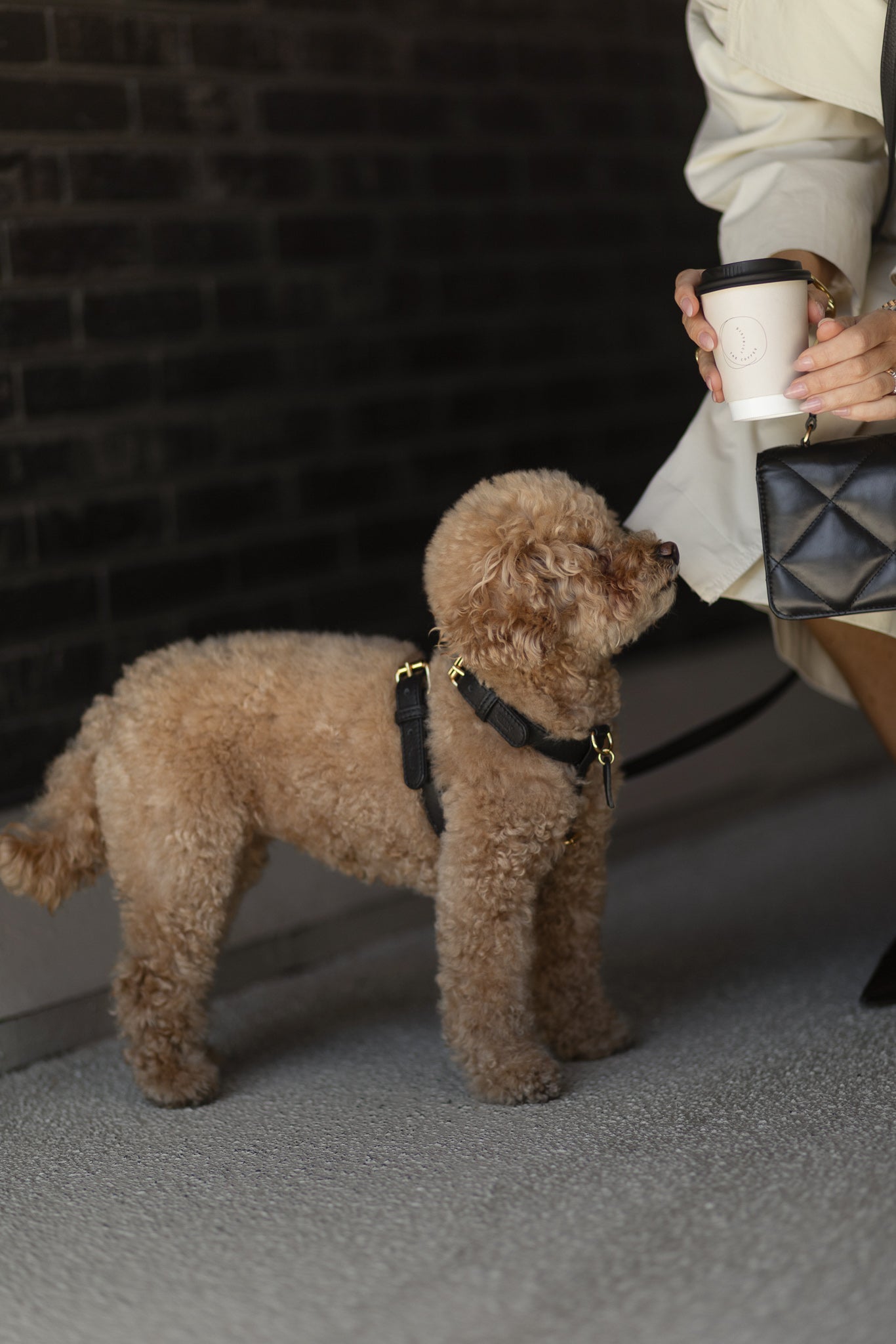
The harness carries the force. During the training months the leash will go tight, often. Clipped to a harness, the force of a pull lands on the chest rather than the throat. Our step-in harness is measured on the chest alone: your dog steps in, you close it over the back and it spreads the pressure evenly across the chest. The H-Harness is measured on neck and chest, goes around the body rather than over the head and spreads the pressure across the chest with fewer pressure points, which is why we suggest it for a dog that still puts real force into the leash. On both, the leash goes on the ring on the back. The small ring at the front holds the hangtag and nothing else. Which of the two suits your dog is set out in our guide to the types of dog harnesses.
Fit decides how the walk feels. A strap across the shoulder blade shortens the stride. A harness that is too loose migrates into the armpit and rubs there. Two fingers, flat, under every strap, and a harness that neither turns on the body nor holds back the shoulder. Size by the tape measure, never by weight, and between two sizes take the larger. Every measurement is in our size guide.
The collar keeps the tag. Leave it on, with room for two fingers underneath, as explained in how tight a dog collar should be. During the training months the leash belongs on the harness.
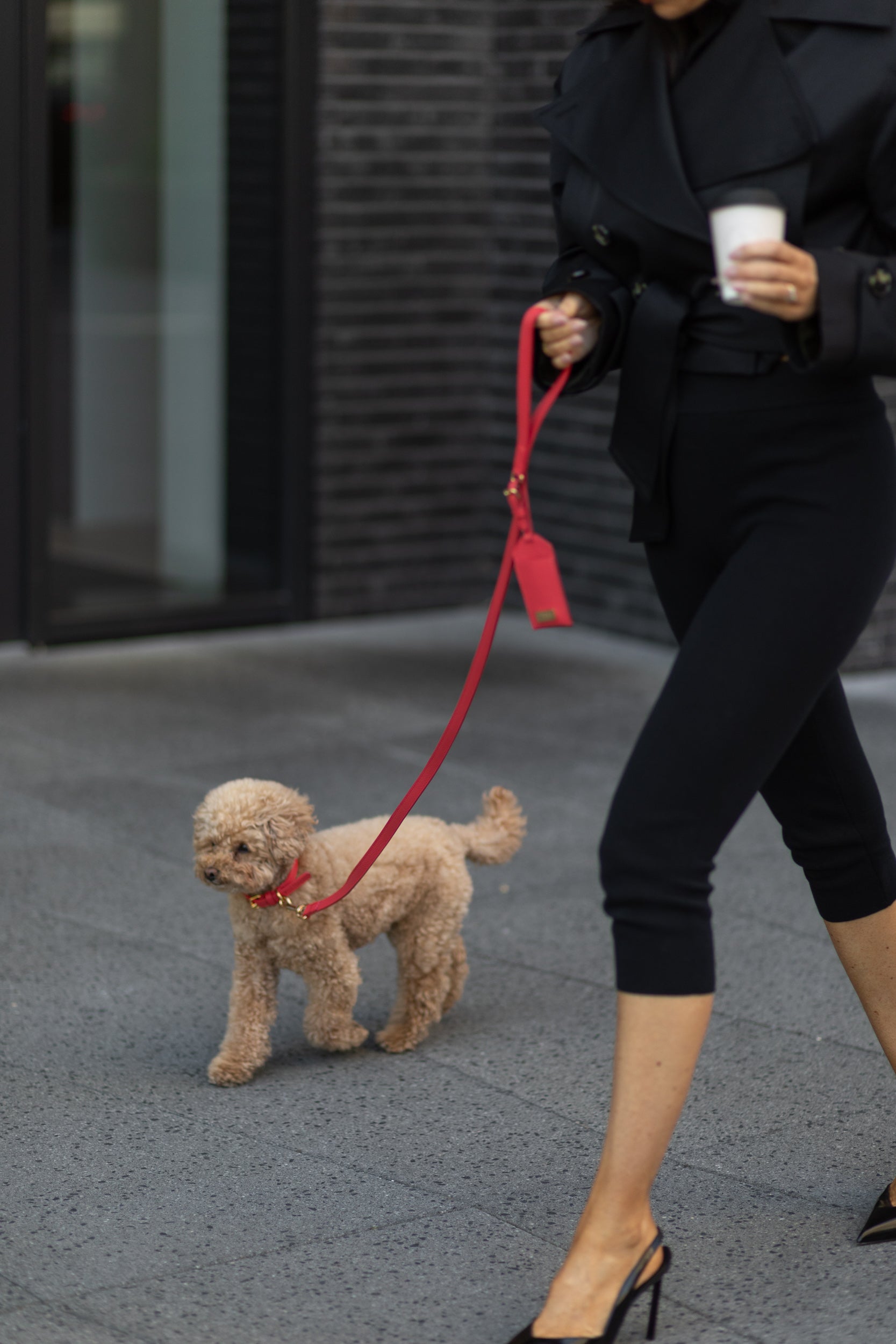
The leash sets the distance. A fixed length, never retractable. Our short leather dog leash is 130 cm and keeps your dog within arm's reach, which suits the short training walk. The long version, 235 or 245 cm, adjusts to three lengths and can be worn cross-body over the shoulder, hands-free: that is the leash for the sniffing walk on open ground. Leather also slides through the hand in a lunge, where nylon webbing grips the palm. Choose the leash in the same width as the harness, 1.5 cm with 1.5 cm and 2 cm with 2 cm, and check the clip before anything else, because that is where a leash takes the load. The reasoning is in how long a dog leash should be.
| Object | Its job during training | What to check |
|---|---|---|
| Harness | Carries the force of a pull on the chest | Two fingers under every strap, nothing on the shoulder blade |
| Collar | Carries the identification tag | Two fingers at the neck, not for the leash while training |
| Short leash, 130 cm | The training walk, dog within reach | Fixed length, a clip that closes with a decisive snap |
| Long leash, 235 or 245 cm | The sniffing walk, in three lengths | Open ground and your full attention |
How Long Leash Training Honestly Takes
Leash training takes one to two weeks for a dog to grasp the idea, two to three months to hold up past mild distraction and six to eighteen months to become the default. Here is the real curve.
| Phase | Roughly | What is happening | What you do |
|---|---|---|---|
| The concept | 1 to 2 weeks | Dog works out tight equals stopped | Indoors, garden, zero distraction |
| Easy outdoors | 2 to 6 weeks | Holds up on a quiet street | Short sessions, keep winning |
| Real world | 2 to 3 months | Works past mild distraction | Add difficulty one notch at a time |
| Adolescence | 8 to 14 months | Much of it appears to vanish | Go back a step. This is normal. |
| Reliable | 6 to 18 months | A loose leash is simply the default | Reward now and then, forever |
Two notes on that table. Adolescence is not failure: in a dog between roughly eight and fourteen months, things you were certain were installed will appear to have been deleted. They have not. Go back to an easier environment for a few weeks and it returns faster than it arrived.
And a dog with a history takes longer than a puppy. A five-year-old that has pulled successfully on every walk of its life has thousands of repetitions to unlearn. It is entirely possible. It is not quick, and anyone telling you otherwise has not done it.
How to Leash Train a Puppy
To leash train a puppy, make the equipment ordinary before the walk begins: the collar indoors from around eight weeks, the harness indoors with a reward, then the leash. A puppy has nothing to unlearn, which is the good news.
Indoors First, Short Always
Make the equipment unremarkable before it means anything
Put the collar on during play and meals and leave the leash off in the first sessions. Let the puppy wear the harness indoors for a few minutes with a reward, take it off again and repeat until it is boring.
Only then clip on the leash: indoors first, then the garden, then a quiet street, with the same two rules as for an adult dog. Keep the sessions short and ask your vet how much walking suits your breed at each age. Re-measure the harness every two to three weeks while your puppy grows. Our guide to collar or harness for a puppy takes you through the first year month by month.
Common Leash Training Mistakes
The most common leash training mistakes are the leash correction, the one exception, anti-pull devices, different rules per person and training a dog that is tired or wound up. Each one teaches your dog that pulling still works, or that walks are unpleasant.
The leash correction. A jerk teaches a dog that a tight leash is a normal sensation, which is the precise opposite of the lesson. It is also usually followed by you continuing to walk in the same direction, which confirms that the pull worked. And on a collar it puts force through a windpipe. It fails on every count at once.
The one exception. The morning you are late. The evening it is raining. You let the dog tow you and tell yourself it was one walk. It was not one walk: it was proof that the rule has a crack, and your dog will spend the next month testing the crack rather than the rule.
The anti-pull harness. These work by tightening somewhere sensitive, usually the armpit, and they work exactly as well as they are unpleasant. They teach nothing. Remove the device and the pulling returns whole, because the dog learned that an object hurts, not that walking beside you is worth doing.
Different rules per person. If one member of the household stops when the leash tightens and another does not, there is no rule. There is a lottery, and your dog will play it. Everyone or no one.
Training a tired dog, or a wired one. A dog that has been alone for six hours cannot do subtle work. Let it move first, then teach.
The Protocol
Frequently Asked Questions
How long does it take to train a dog to walk on a leash?
Weeks for the idea, months for reliability. Most dogs grasp that a tight leash stops the walk within one to two weeks of consistent practice. Walking calmly past mild distraction takes two to three months, and a loose leash becomes the default after six to eighteen months. Adolescence, roughly eight to fourteen months, often undoes part of the progress, which is normal. A dog that has pulled for years needs longer than a puppy.
What is the fastest way to leash train a dog?
There is no shortcut, but there is a fastest route: short sessions of ten to fifteen minutes indoors without distraction and a leash that never moves forward while it is tight. Reward the place beside you generously at first. Most dogs grasp the rule within one to two weeks; skipping steps costs you months later.
Why does my dog pull on the leash?
Because it works, and because of a reflex. Every time a dog leans forward and the walk continues, pulling has been rewarded. Dogs also have an opposition reflex, an instinct to push back against steady pressure, so a tight leash physically encourages a dog to pull harder. Pulling is not defiance. It is a habit that has been accidentally reinforced many times.
Why doesn't my dog want to walk on a leash?
Usually because the leash is new, or because something about the walk frightens the dog. A puppy that has never worn a collar, harness or leash may not understand what is being asked. A recently rescued dog may have a history you do not know, and a busy street can bring out fear as growling, barking or lashing out. Start at home with the harness and leash on, practise sit and stay with good treats, move to a quiet garden and only then try a quiet street. If the fear persists, consult a qualified force-free behaviourist.
What is loose leash walking?
Loose leash walking is a dog walking beside you while the leash hangs in a loose J between you, never tight. It rests on two rules: a tight leash never moves forward, and the position beside your leg is rewarded, generously at first and then now and then. In Britain the same skill is called loose lead walking.
Is a harness or a collar better for leash training?
A harness. During the training months the leash will go tight, and on a harness the force of a pull lands on the chest rather than the throat. Keep the collar for the identification tag. On both Perro Collection harnesses, the step-in harness and the H-Harness, the leash goes on the ring on the back and the small ring at the front holds the hangtag only.
How do I stop my dog pulling on the lead?
Stop the moment the lead goes tight and move on only when it is slack, every time, with everyone who walks the dog. If waiting does nothing, walk backwards calmly. Reward your dog for walking beside you and clip the lead to the back ring of a well-fitted harness rather than to the collar.
Should I jerk the leash to stop my dog pulling?
No. A leash correction teaches a dog that a tight leash is a normal sensation, and on a collar it puts force on the neck. It also rarely communicates anything, because you usually keep walking in the same direction afterwards, which confirms the pull worked. Standing still and changing direction works better.
Should my dog be allowed to sniff on walks?
Yes. Scent is how a dog reads the world, and sniffing helps the training rather than hindering it. Separate the two: short, deliberate training walks where loose leash walking is the task and longer walks on a longer leash where the dog is free to investigate.
When can I start leash training a puppy?
Start with the equipment, not the walk. Introduce the collar indoors from around eight weeks, without a leash in the first sessions, and let the puppy wear the harness indoors for a few minutes with a reward until it is boring. Then clip on the leash indoors, then in the garden, then on a quiet street. Keep sessions short and ask your vet how much walking suits your breed.
The Slow Thing
Nothing in this method is sophisticated. Stop when the leash tightens. Pay for the right position. Do not make exceptions. Let the dog sniff. Wait longer than you want to.
The difficulty was never the technique. It is that the technique asks you to be more consistent than you are naturally inclined to be, on a wet Tuesday, at seven in the morning, when you are late. Your dog is capable of learning this in a matter of weeks. Whether it does is almost entirely a question of whether you can keep one rule for two months without a single crack in it.
And when it lands, it does not feel like obedience. It feels like the two of you have finally agreed on a pace.
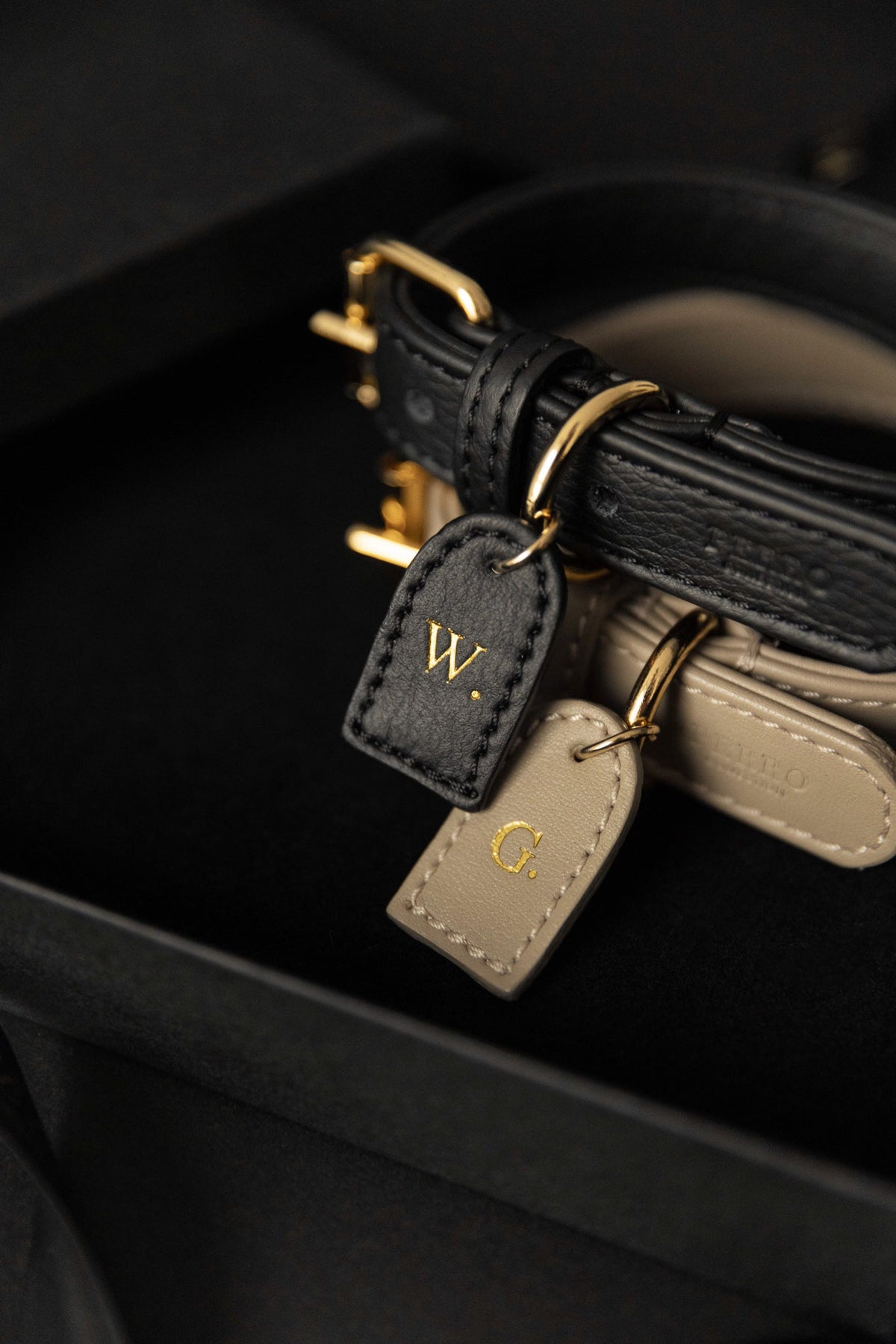
A fixed leather dog leash and a properly fitted step-in harness or H-Harness. Nothing more. Perro Collection leashes and harnesses are handcrafted in our own atelier in Tuscany, Italy, from Italian cow leather, with multi-layer gold-coloured hardware. Every harness can carry your dog's initial on the hangtag, free of charge. Explore the complete Walk collection.
One rule. No exceptions. Considerably more patience than feels reasonable.





Leave a comment
All comments are moderated before being published.
This site is protected by hCaptcha and the hCaptcha Privacy Policy and Terms of Service apply.