

How long should a dog leash be? As long as the walk you actually take. Short, at 130 cm, keeps your dog within arm's reach on pavements and public transport. Long, at 235 or 245 cm, gives your dog room to read the ground in parks and on quiet paths. Perro Collection leather leashes are handcrafted in our atelier in Tuscany, Italy, from Italian leather, in exactly those two lengths, with rounded edges and multi-layer gold-coloured hardware. This guide covers length, material and the checks that matter before you buy.
Consider the arithmetic. Two walks a day, every day, for the life of a dog: thousands of occasions on which you pick up a leash, hold it for forty minutes and put it down again. And yet the leash is routinely the afterthought of the purchase. This is odd, because it is the only object in the arrangement that you hold. The collar is your dog's. The harness is your dog's. The leash is shared, and every piece of information between the two of you passes through it: hesitation, curiosity, the small pull toward a smell.
Short leash, 130 cm (about 4 ft 3 in): pavements, traffic, public transport.
Long leash, 235 or 245 cm (about 7 ft 8 in to 8 ft): parks and quiet paths. It adjusts to three lengths and can be worn cross-body, over the shoulder, for hands-free walking.
Check the clip and the stitching first. That is where a leash fails.
Match the width to the collar or harness: 1.5 cm with 1.5 cm, 2 cm with 2 cm. On a harness, clip to the back ring.
How Long Should a Dog Leash Be?
Choose the length for the walk you take. Perro Collection makes two. The short leash, 130 cm (about 4 ft 3 in), keeps your dog close on busy pavements and public transport. The long leash, 235 or 245 cm (about 7 ft 8 in to 8 ft), adjusts to three lengths and gives your dog room on open ground.
Most people own the length they were handed. It is worth choosing it instead, because the number determines what kind of walk is even possible.
Short
Crowded pavements, traffic, close quarters
The dog stays within arm's reach and there is no loop of slack to trip over or to catch on a passing pushchair. On a narrow pavement beside moving traffic this is not a preference, it is a margin. A short leash also makes queues, cafés and public transport considerably less eventful.
The cost is honesty about what you are giving up: a dog on a short leash cannot really sniff, and sniffing is most of what a walk is for a dog. This is a tool for a specific environment, not a default.
Long
Parks, quiet paths, dogs that need to read the ground
A long leash changes the character of a walk. The dog can range, circle, follow a scent for six or seven paces and come back, all without the leash ever going tight. For a dog whose walk is primarily an olfactory event, and that is most dogs, this is the difference between exercise and enrichment.
Our long leash adjusts to three lengths, so it can be shortened when the path narrows and let out again when it opens. It can also be worn cross-body, over the shoulder, so you walk your dog hands-free. It still requires space and a handler paying attention. A long leash at full length in a crowd is a hazard to everyone in it.
A correctly walked dog leaves the leash hanging in a loose J between you. If your leash is a straight line, either it is too short for the walk or your dog is pulling. Both are fixable. The straight line is not the goal.
Perro Collection leashes. Two lengths, each in two widths, taken unchanged from our size guide.
| Type | Length | Width | Pairs with |
|---|---|---|---|
| Short S | 130 cm | 1.5 cm | 1.5 cm collar or harness |
| Short M | 130 cm | 2 cm | 2 cm collar or harness |
| Long S | 245 cm | 1.5 cm | 1.5 cm collar or harness |
| Long M | 235 cm | 2 cm | 2 cm collar or harness |
The Fur leashes, with a handle in genuine Montone fur, come in the short length only. Every leather dog leash in the range is made to pair with the collar collection in matching leather and colour. Beyond the long leash you are no longer choosing a walking leash: a long line is a recall training tool for open ground, and it belongs in a different conversation.
A leash is not a brake. It is a sentence you and your dog are writing together.
Is a Short or a Long Leash Better?
Neither is better everywhere. A short leash gives you immediate control where space is tight and traffic is close, at the cost of your dog's room to investigate. A long leash turns the walk into time to read the ground, but it needs space and your attention. Our long leash adjusts to three lengths, so one leash covers both.
Keep the leash short when you want your dog close: at a kerb, in a queue, on a train. Let it out when you want to give your dog more space: on a lawn, along a quiet path, wherever the ground is worth reading. The choice is not about the dog's size. It is about where you walk.
If you are weighing a 4-foot against a 6-foot leash, know that we make neither exactly. Our short leash is 130 cm, about 4 ft 3 in. Our long leash is 235 or 245 cm at full length, about 7 ft 8 in to 8 ft. It can be taken in. If you walk in the city and in the park, the long leash is the one that adapts.
What Should You Check Before You Buy a Leash?
Check the clip and the stitching around it, because that is where a leash takes the load and fails. Work the spring with your thumb: it should close with a decisive snap and the swivel should have no play. Where the leather folds back around the clip, the stitching should be dense and even. The rest is a handle.
Leashes do not break in the middle. They break at the clip, or at the stitch holding the clip, and that is where the entire purchasing decision quietly lives. Think about the load path. Your dog sees a cat. All of that decision travels the length of the leash and arrives, at once, at a single small metal fitting and the seam attaching it to the strap. Those two centimetres are the product.
The clip. A decisive snap, not a soft click, and no play in the swivel. Cheap fittings are cast from soft alloy and deform gradually rather than failing loudly, which is worse: you do not get a warning. Our hardware is multi-layer gold-coloured, engineered to resist tarnishing, because a walking object lives its life in rain and mud, and every clasp, ring and fitting is assembled by hand.
The stitch. Look at where the leather folds back on itself around the clip. You want dense, even stitching, and you want it doubled. A rivet alone is not a construction, it is a hole punched through the load path. Our leashes are reinforced at the stress points, with rounded edges for comfort in the hand. Each leash takes 2 to 3 hours of handwork.
Twice a year: work the clip spring, check the swivel for play, run a thumbnail over both seams and look for a raised or frayed thread. That is the entire maintenance schedule for the hardware of a well-made leash.
Is a Leather Leash Better Than Nylon?
For your hand, usually yes. A leather leash softens with use and takes the shape of your grip. When a dog lunges and the leash runs through your hand, leather slides where nylon webbing grips. Leather does ask for a little care, should be kept dry and is not the right choice for a dog that swims on every walk.
We make leather leashes, so treat this section accordingly. The argument survives the disclosure. Everything else in this category is judged by what it does to a dog. The leash is judged by what it does to a hand, and that changes the criteria entirely.
A new leather leash is stiff. Within weeks it begins to soften, and within a couple of months it drapes: it folds where your hand folds it, it hangs in the loose J it is supposed to hang in and it develops a subtle patina. Nylon does not do this. It stays exactly as it began, and there is a specific moment where that matters: the lunge. Leather, at the same speed, slides.
Our Walk collection is made in three qualities of Italian cow leather: full grain nappa with a smooth finish, bovine grained leather with a subtle pebble structure and natural grain leather. All of it comes from LWG-certified tanneries with a Gold Rating. Leather is a skin, and it can stretch, so do not let the leash drag on the ground and keep it dry. A few minutes with the leather care set keeps it supple, and our guide on how to take care of leather covers the rest. A dog that swims on every walk should have a synthetic leash.
| Leather | Nylon webbing | Retractable | |
|---|---|---|---|
| Softens with use | Yes | No | No |
| In a lunge | Slides through the hand | Grips the palm | Thin cord, hard to hold |
| Over the years | Develops a patina | Stays as it began | Mechanism can fail |
| Constant tension | None | None | Always |
| Control at distance | Full | Full | Minimal |
| Care | A few minutes, kept dry | None | None possible |
| Dog swims daily | Not suitable | Good | Poor |
Are Retractable Leashes Bad?
We advise against them, particularly for a young dog. A retractable leash keeps a spring under constant tension, so your dog feels a steady pull on every walk, and pulling against it produces more line. The brake is a button you must find in a hurry, and several metres of cord give you little control near a road.
The constant tension is not a design detail, it is the whole objection. You have built a machine that teaches the exact behaviour you are trying to prevent, and it runs for forty minutes a day, twice a day, with perfect consistency. Nothing in your training will out-teach it.
If your dog needs range, use a long leash in open space and use it deliberately. If your dog needs to be near you, use a fixed short leash. The retractable is an attempt to be both and succeeds at neither. The training that actually solves pulling is in how to teach a dog to walk on a lead.
Should the Leash Clip to the Collar or the Harness?
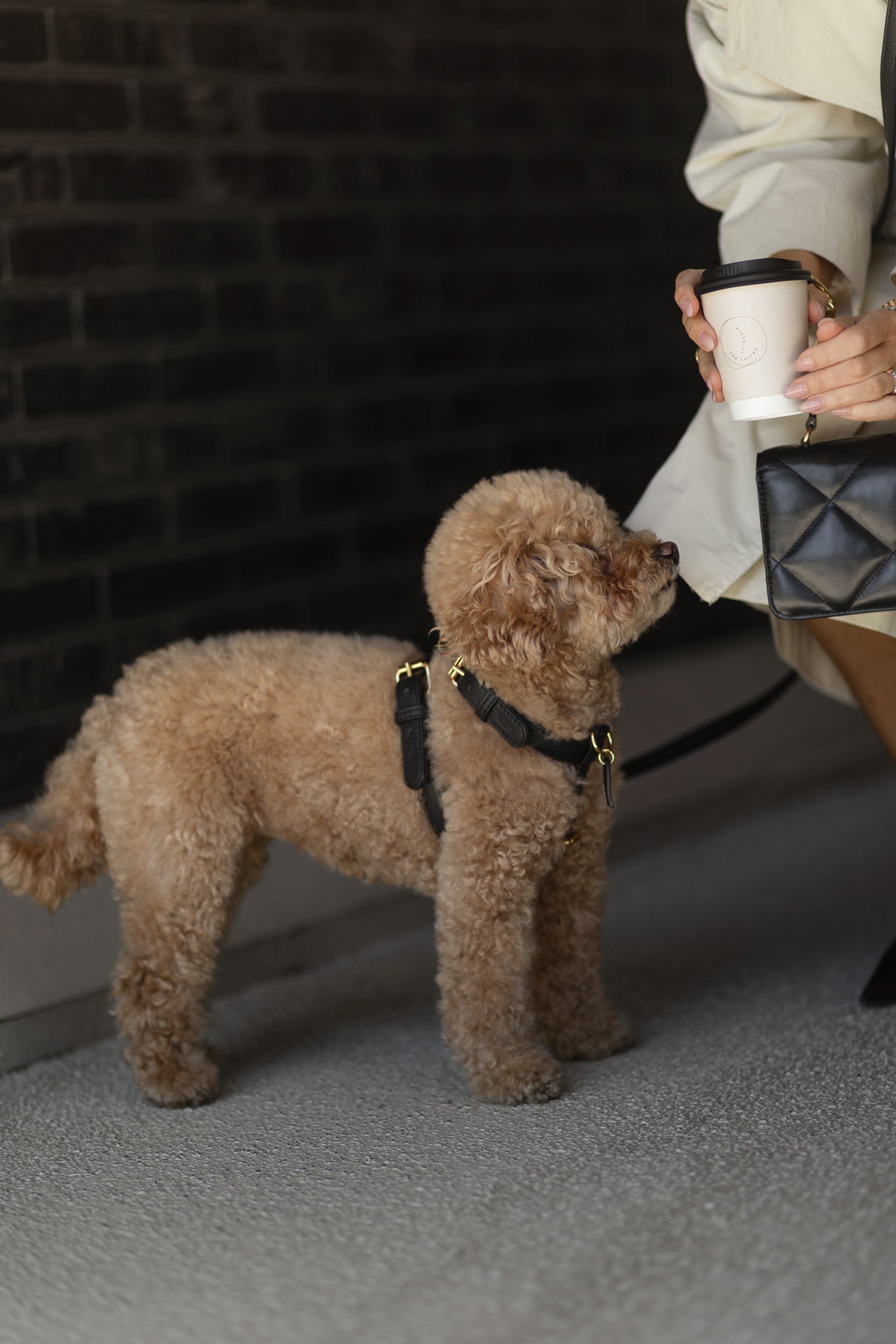
During the training months, clip the leash to a harness, so the force lands on the chest rather than the windpipe. On both Perro Collection harnesses the leash goes on the ring on the back, between the shoulder blades. The front ring holds the personalised hangtag only. Choose a leash in the same width as the harness.
Both of our harnesses are built around that back ring. The step-in harness closes over the back after your dog steps in, and the H-harness is placed around the body rather than over the head. For the fit itself, see how a dog harness should fit.
Buying a Leash: The Short Version
Frequently Asked
What lengths do Perro Collection leashes come in?
Two lengths. The Perro Collection short leash is 130 cm, in a width of 1.5 or 2 cm. The long leash is 245 cm in a width of 1.5 cm or 235 cm in a width of 2 cm. It adjusts to three lengths. The Fur leashes come in the short length only.
Which leash goes with my collar or harness?
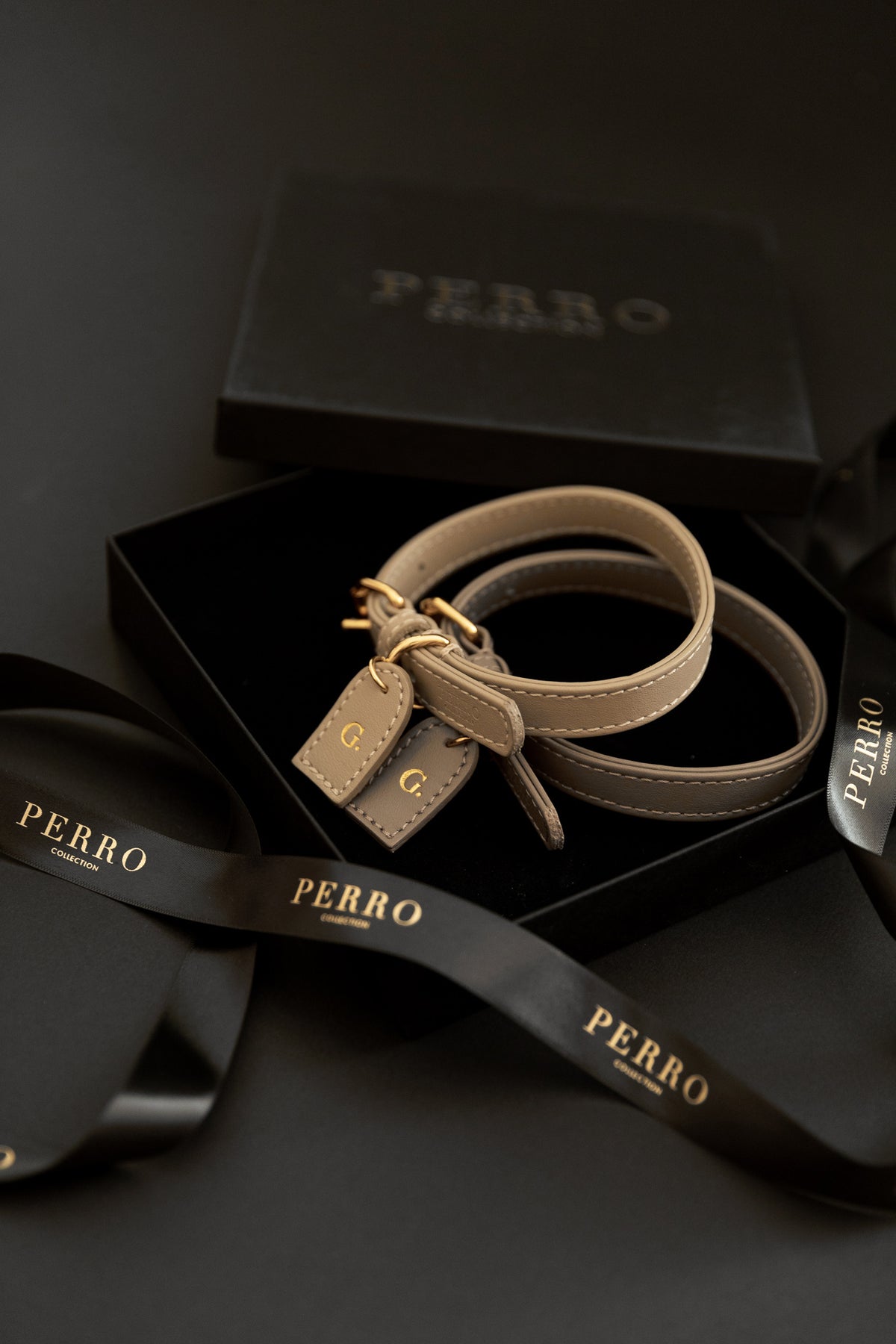
Choose the leash in the same leather width as the collar or harness it clips to: a 1.5 cm leash with a 1.5 cm collar or harness, a 2 cm leash with a 2 cm one. Every Perro Collection leash pairs with the collar or harness in the same colour.
Can the long leash be worn hands-free?
Yes. The Perro Collection long leash adjusts to three lengths and can be worn cross-body, over the shoulder, so your hands stay free on the walk. Keep it short when you want your dog close and let it out when you want to give your dog more space.
Is a dog lead the same as a dog leash?
Yes. Lead is the British word and leash the American one. Both describe the strap between your hand and your dog's collar or harness. Perro Collection calls its product a leash and uses both words in its guides.
Where do dog leashes usually break?
At the clip, or at the stitching that holds the clip, because that is where the full force of a pull arrives. Twice a year, work the clip spring, check the swivel for play and run a thumbnail over both seams to look for a raised or frayed thread.
How do I care for a leather leash?
Wipe away dust with a soft cloth, do not let the leash drag on the ground and keep it dry. A few minutes with a leather care product twice a year keeps it supple. For a dog that swims on every walk, a synthetic leash is the practical choice.
Where are Perro Collection leashes made?
Perro Collection leashes are handcrafted in the brand's own atelier in Tuscany, Italy, from Italian leather, with rounded edges and multi-layer gold-coloured hardware. Orders ship worldwide from the Netherlands.
Seven Thousand Walks
The leash outlasts almost everything else you will buy for your dog. The collar is replaced as the dog grows. The leash, if it is any good, is bought once and is still there at the end, softer and darker and shaped by years of the same hand.
That is worth about ninety seconds of thought at the point of purchase. Choose the length for the walk you actually take, not the one you imagine. Check the clip, because the clip is the product. Pick the material you will still want to hold in year eight. Then hang it by the door and stop thinking about it, which is what a good object is for.
Explore the leather leash collection, pair it with a matching collar or see the complete Walk collection. Handcrafted in Tuscany, shipped worldwide from the Netherlands.
Buy the length you walk. Check the clip. Hold it for years.


Leave a comment
All comments are moderated before being published.
This site is protected by hCaptcha and the hCaptcha Privacy Policy and Terms of Service apply.