
There is a particular kind of panic that sets in the week before a puppy arrives. It expresses itself as a shopping cart: three collars in ascending sizes, a retractable lead, a harness chosen by weight class, a training clicker, and a set of opinions absorbed from six different forums at two in the morning. Almost none of it survives contact with the actual dog.
Here is what a decade in the atelier has taught us. A puppy needs remarkably little in the first year, but the little it needs has to be right, because this is the window in which a dog forms its entire relationship with being handled, restrained and walked. Get the equipment wrong and you are not merely uncomfortable. You are teaching.
What follows is not a product list. It is the reasoning underneath one.
Collar or Harness
This is framed as a choice. It is not. A puppy needs both, and they do entirely different jobs.
A collar is an identity object. It carries the tag, it lives on the dog, and in most of Europe it is a legal requirement that your dog is identifiable in public. A harness is a load-bearing object. It exists to distribute the force of a lead across a body that can take it.
The mistake is not choosing one over the other. The mistake is attaching the lead to the wrong one at the wrong age.
The Collar
Identification, presence, and the first lesson in being worn
Introduce it indoors, early, and without ceremony. Around eight weeks is standard. Put it on during play, during meals, during the ordinary business of the day, and take it off again before the puppy has time to form an opinion. Do not attach a lead in the first sessions. The entire objective is that the puppy stops noticing.
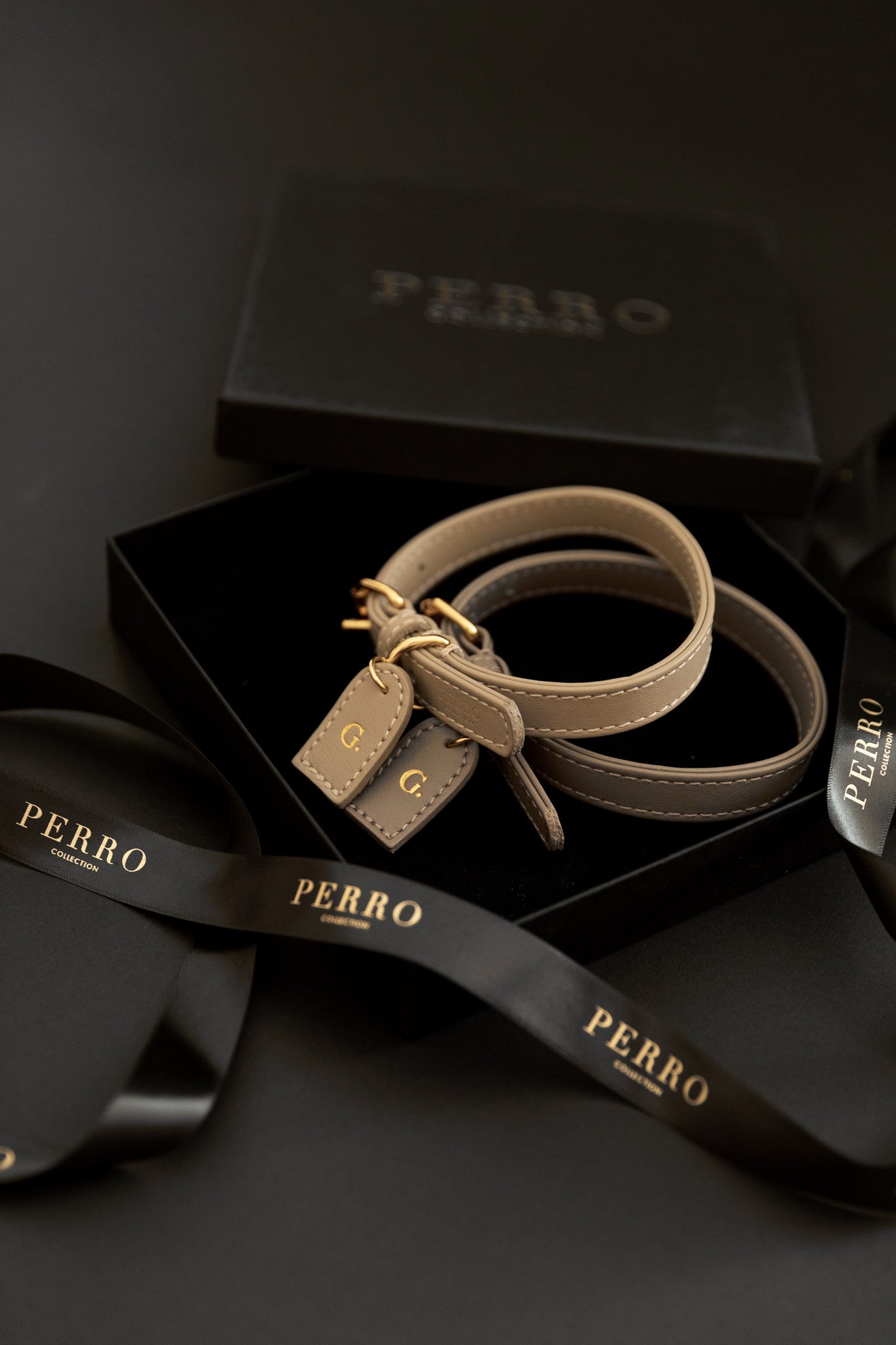
What matters in the object itself: a smooth edge that will not abrade a soft neck, a buckle that closes with certainty, and enough adjustment range that you are not replacing it in six weeks. Leather earns its place here for a reason that is easy to dismiss as marketing and is not: it softens with body heat and takes the shape of the individual dog. Nylon does not. It stays exactly as rigid on day four hundred as it was on day one.
A collar worn from week eight is a collar the dog never questions. A collar introduced at six months, on a dog that has never worn one, becomes a negotiation you did not need to have.
The Step-In Harness
One measurement, one motion, a few seconds
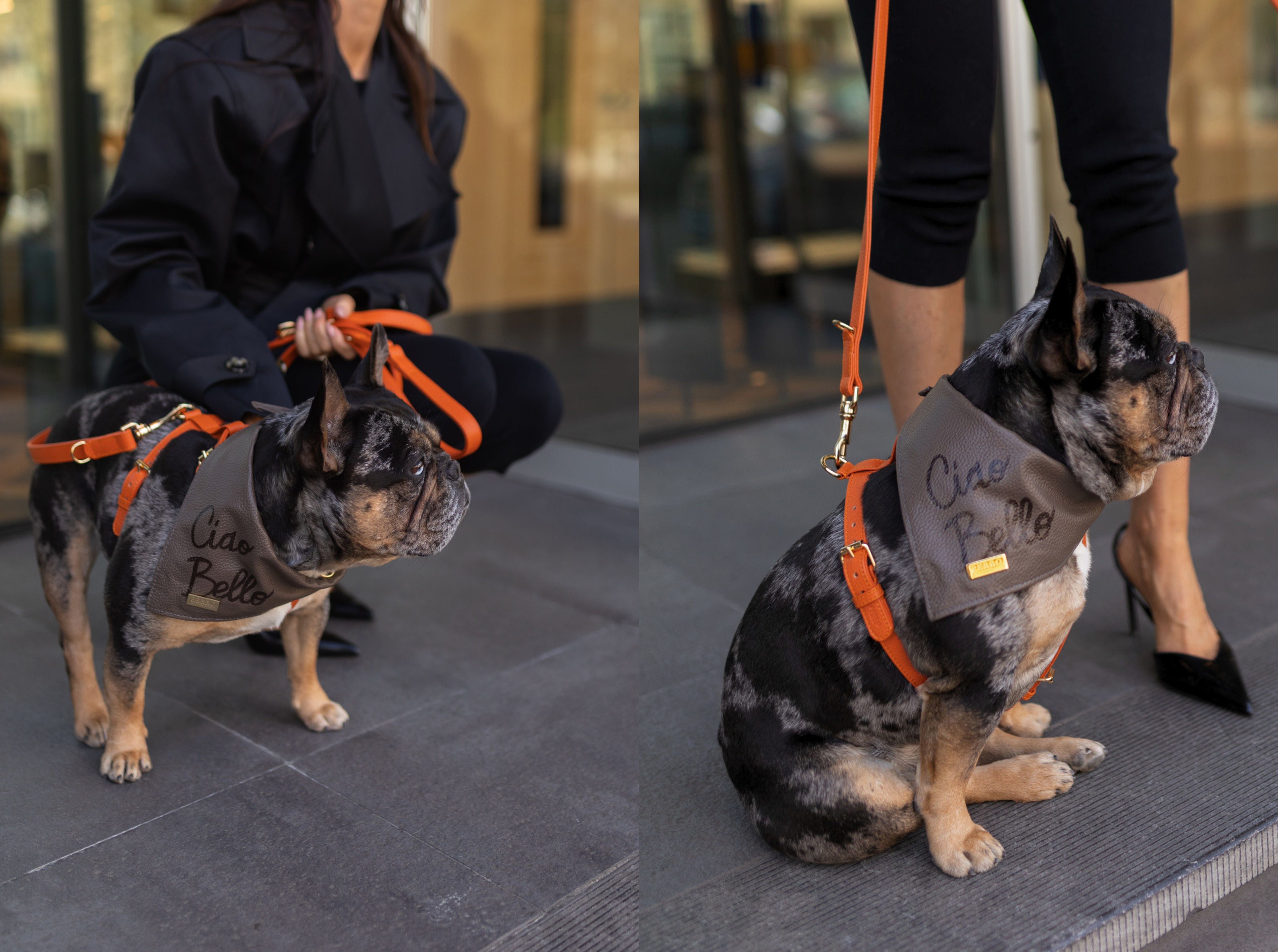
A step-in harness is put on from below: the puppy places its front paws into two openings, and the harness closes over the back. Nothing passes over the head. No hand near the face, no fabric across the eyes. For a puppy that has decided, with total conviction, that objects approaching its skull are a threat, this single detail is the difference between a walk and a wrestling match.
It is also the easier object for the person, and it is sized on one number: chest circumference, nothing else. Each one takes between two and a half and four hours of hands-on work in our atelier in Tuscany: pattern construction, cutting, edge finishing, stitching, hardware assembly. Proportion on a harness cannot be rushed, because the object sits across the chest and shoulders and every millimetre of the pattern is felt.
You want the simplest possible object. Your puppy is small or impatient, and you are the one doing the fastening several times a day.
The H-Harness
Two measurements, and pressure spread more widely
First, the thing almost every other brand cannot say: ours does not go over the head either. The conventional H-harness is dropped over the dog's skull and then buckled, which is exactly the motion a head-shy puppy objects to. Ours is placed around the body. You are not trading away the one advantage of the step-in to get the advantages of the H.
What you gain is the second measurement. The H-harness is sized on neck circumference as well as chest, and a harness fitted at two points around the body rather than one distributes pressure more widely. For a puppy that will grow into real weight, or that is already showing the enthusiastic forward lean that becomes a pulling habit, that spread is worth the extra thirty seconds. The Marrone H-Harness in natural grain leather is where most owners begin.
Your puppy will be a large or powerful dog, pulls already, or you simply want the more precise fit. Two numbers instead of one, and the load spread across more of the body.
On both harnesses the lead attaches to the D-ring on the back, between the shoulder blades. The small ring at the chest carries the hangtag and nothing else. It is not rated for a lead. Worth knowing on day one rather than discovering it later.
Both harness types are covered in far more anatomical detail in our guide to how a dog harness should fit. Browse the full step-in harness collection or the H-harness collection to see the two constructions side by side.
A puppy does not learn from your intentions. It learns from the object touching its body.
Sizing a Moving Target
Here is the problem nobody warns you about: you are fitting equipment to an animal that will not hold still, and not in the way you think. A Labrador puppy can add several centimetres of chest girth in a fortnight. The harness that fitted perfectly on Sunday is a restriction by the following Friday, and your dog will not tell you.
Two rules, and they are not negotiable.
Measure, never guess by weight. Every size chart that sorts by kilograms is making an assumption that does not survive contact with reality. A fifteen-kilogram French Bulldog and a fifteen-kilogram Whippet do not share a chest. One is a barrel, the other is a blade. Weight-based sizing puts both in the same box and one of them will be wrong. Take a soft tape, have the dog standing on all four legs, and measure the chest at its widest point, immediately behind the front legs. That number, and only that number, chooses the size. Our size guide will do the rest.
Re-measure every two to three weeks. Put it in your calendar the way you would a vaccination. It takes ninety seconds. The alternative is a dog that has been quietly uncomfortable for a month and has drawn a conclusion about walks that will take you far longer than ninety seconds to undo.
| Phase | Roughly | What changes | What to do |
|---|---|---|---|
| Settling in | 8 to 12 weeks | Collar becomes normal | Indoors only, no lead |
| First outings | 12 to 16 weeks | Harness introduced | Measure every 2 weeks |
| Fast growth | 4 to 8 months | Chest girth climbs quickly | Expect a size change |
| Adolescence | 8 to 14 months | Frame fills out, pulling peaks | Re-check monthly |
| Settled | From 12 to 18 months | Size stabilises | Buy the piece that lasts |
A note on breed, because the table above is an average and your dog is not. Small breeds are close to final size by twelve months. Giant breeds are still building frame at two years. Ask your breeder or your vet where your particular dog sits on that curve before you commit to a piece meant to last.
What Actually Matters
We are, admittedly, not neutral here. But the argument stands on its own even if you buy nothing from us.
Leather is not a luxury flourish on a walking object. It is a functional decision. Leather is a fibre structure that responds to heat and pressure: worn against a body, it softens, it drapes, and over a few weeks it takes on the specific geometry of the specific dog. A leather harness at month three fits better than it did at week one, because it has been quietly learning the shape.
Synthetic webbing does not do this. It is dimensionally stable, which is precisely the problem: it presents the same edge, at the same angle, to the same patch of skin, every single walk. That edge is where the rubbing starts. It is why chafing under the front legs is the most common complaint in the entire category, and why it is disproportionately a nylon complaint.
The second argument is longevity, and it is the one that decides the arithmetic. A good leather collar outlives four nylon ones. Across the working life of a dog, the object you thought was expensive turns out to have been the cheap decision, and it will look better at the end than the alternative did at the start. The leather care set is the whole maintenance programme: a few minutes, twice a year.
We work in cow leather throughout, selected per colour: bovine grained leather for the pebbled finishes, natural grain for Nero, Marrone and White Wedding, nappa and full grain nappa for the smooth colours. All hardware is multi-layer gold plated, engineered to resist erosion and tarnishing.
One Lead, Not Four
You need a fixed-length lead. That is the whole recommendation.
Not a retractable one. A retractable lead teaches a puppy that forward pressure produces forward movement, which is the exact lesson you will spend the next two years trying to reverse. It also removes any meaningful sense of where your dog is. During the months in which a dog is deciding what a lead means, the lead should mean one consistent thing.
Length is a function of what you are actually doing. For city walking with a puppy, something around a metre and a half keeps the dog within reach without dragging. Our full reasoning on length, hardware and construction is in the guide to choosing a dog lead, and the range is here: leather leashes.
The First-Year Checklist
The Quiet Argument
The pet industry would prefer you buy nine things. You need four: a collar, a harness suited to your particular dog, one fixed-length lead, and a tape measure you actually use.
What the industry is less keen to mention is that this year is not really about equipment at all. It is the year your dog decides what being handled feels like, whether a lead means pressure or partnership, and whether the thing around its chest is something to tolerate or something it stops noticing. Every object you choose is casting a vote in that decision.
Choose few things. Choose them properly. Measure more often than feels necessary.
Explore the collar collection, the step-in harness and the H-harness, or see the complete Walk collection. Handcrafted in Italy, personalised with one initial, free.
Fewer objects. Better objects. Measured more often than you think you need to.

Leave a comment
All comments are moderated before being published.
This site is protected by hCaptcha and the hCaptcha Privacy Policy and Terms of Service apply.