
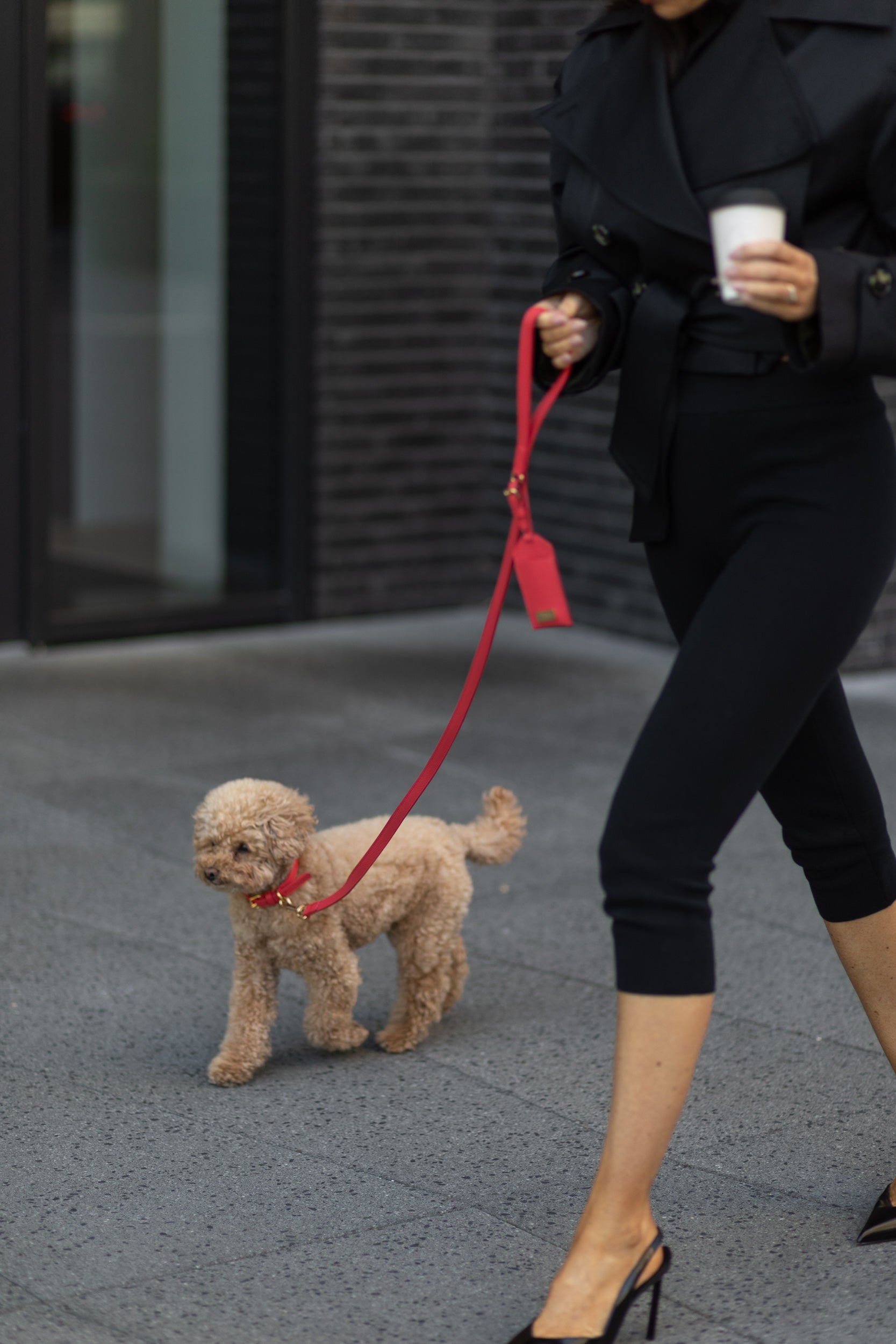
There is no genetic instruction in any dog that says: walk at the speed of the human, on the left, without leaning. It is an entirely artificial request. We are asking an animal built to trot at fifteen kilometres an hour to accompany us at four, past a landscape saturated with information it can read and we cannot, and to do this while attached to us by a strap. Framed honestly, it is a remarkable thing that any dog ever agrees.
Which is why the language around this subject is so unhelpful. Dogs are described as stubborn, dominant, badly behaved. They are none of those things. They are fast, they are curious, and they have learned something perfectly logical that you taught them by accident.
This is the method. It is not clever, it does not work in a weekend, and it asks considerably more of you than it does of your dog.
Why Dogs Pull
Two reasons. Both are your allies once you understand them, because both are mechanisms rather than character flaws.
It works. This is the whole of it. Your dog leans forward, and the walk continues in the direction of the lean. Repeat that across a few hundred walks and you have run one of the most consistent training programmes in the history of animal learning: pulling produces forward movement. It has never once failed. Your dog is not ignoring your training. Your dog has been paying very close attention to a lesson you did not know you were giving.
The opposition reflex. The second reason is physical and it catches almost everyone out. Dogs, like most animals, instinctively push back against steady pressure. Press a hand into a dog's side and it leans in. Apply steady tension to a lead and something in the dog leans forward against it. This means a tight lead is not a signal to slow down. It is a signal, at the level of reflex, to pull harder. You are holding one end of a feedback loop.
Both facts point to the same place, and the entire method fits in one sentence.
You are not teaching your dog to stop pulling. You are teaching it that a tight lead is the only thing in the world that does not work.
Four Parts
Set the Conditions
Most training failures are conditions failures, not method failures
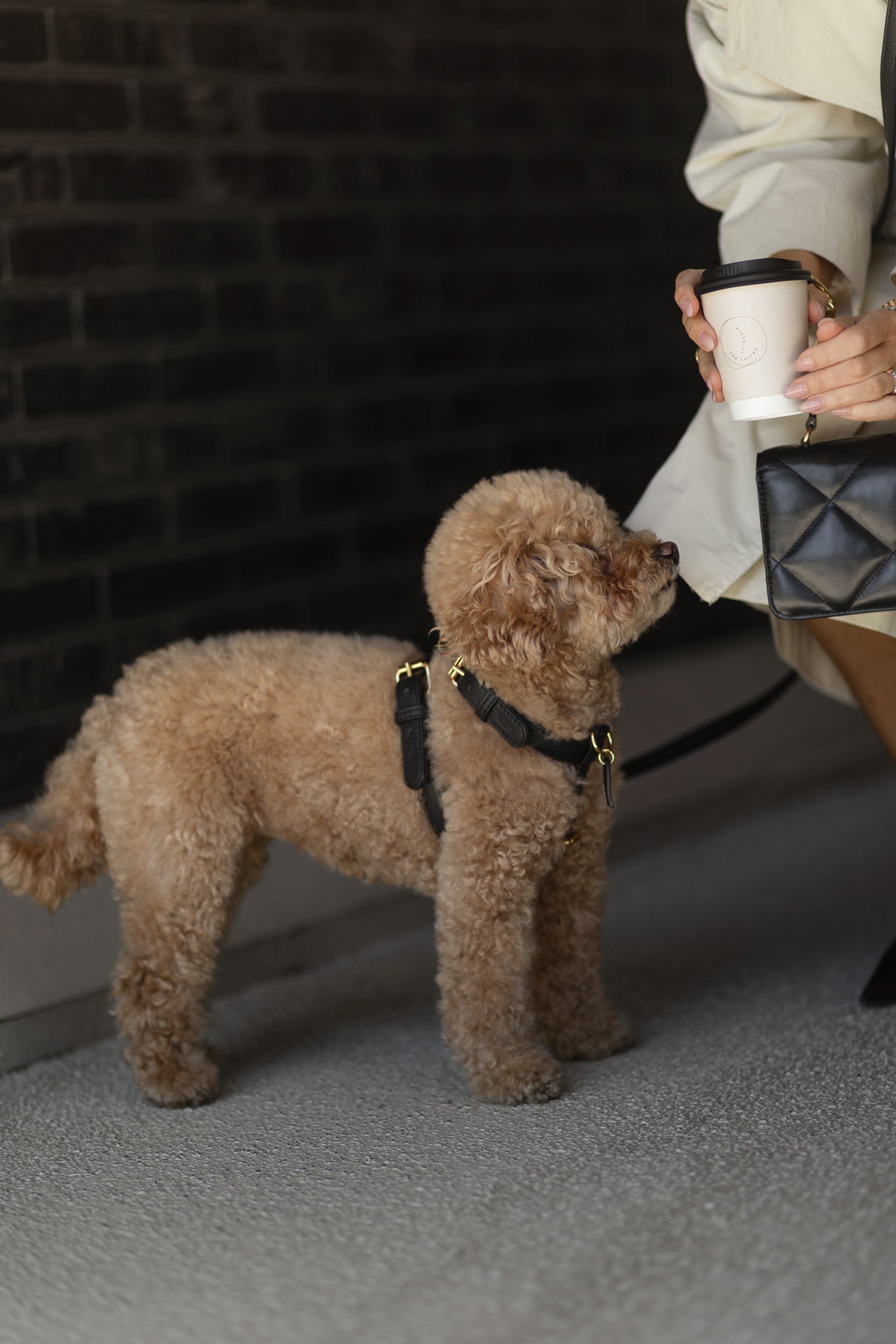
Fixed lead, on a harness. Around a metre and a half. Never retractable: a retractable lead maintains constant tension, which means it is running the opposite lesson at all times, and it will out-teach you because it never gets tired. Attach to a harness rather than a collar, because during training the lead will go tight, and force belongs on a chest plate rather than a windpipe. Use the D-ring on the back, never the chest ring, which carries the hangtag only. Fit matters here more than most people think: a harness pressing on a shoulder blade produces a dog that finds walking mildly unpleasant, and unpleasant is a poor foundation. The full explanation is in how a harness should fit.
Start where nothing is happening. Your hallway. Your garden. If your dog cannot walk beside you in an empty corridor, it certainly cannot do it past a park at four in the afternoon, and starting there teaches only that you can both be frustrated together. Add difficulty when the easy version is boring.
Find the currency. Whatever you are offering must beat a lamp post. Dry biscuit does not beat a lamp post. Cheese, sausage, dried liver: something with an opinion. You are competing with an entire scent landscape and you must actually compete.
A Tight Lead Never Moves Forward
One rule, no exceptions, and the exceptions are what break it
The moment the lead goes tight, you stop. Not a tug. Not a word. You become, instantly and completely, a post in the ground. You wait. Your dog will hit the end, be puzzled, look around, and eventually the tension will slacken, either because it stepped back or because it turned to see what has happened to you. The instant the lead is loose: mark it, reward it, and walk on.
If waiting produces nothing, walk backwards. Not a jerk, just a calm reversal. The dog has to come with you, the lead loosens, and you have made the point without touching the dog: forward is available only on a slack lead.
Here is the part everybody underestimates. This works only if it is absolute. One walk where you were late and let the dog tow you to the corner has not merely failed to teach: it has taught something worse than nothing. Intermittent rewards are the most durable kind, which is precisely why slot machines work. Let the pull succeed once a week and you have not built an inconsistent habit. You have built an obsessive one.
You will not reach the end of your street. Accept this in advance. You are not going for a walk, you are running a training session that happens to be outdoors. Do the walk separately, in the car, in the garden, wherever the rule can be kept.
Reward the Position, Not the Absence
Stopping teaches what fails. Something has to teach what works.
Part two only ever communicates a negative: this does not work. On its own it produces a dog that has stopped pulling and has no idea what it is supposed to do instead, which is a strange, hesitant, slightly anxious animal. You have removed a behaviour and installed nothing.
So pick a place. Beside your left knee is traditional, the right is equally fine, but choose one and never change it. Then pay for it, generously and often. In the first sessions, every three or four steps your dog spends in that spot: mark, reward. You are not waiting for perfection to appear so you can acknowledge it. You are manufacturing it, one paid step at a time, until standing next to your leg becomes the most reliably profitable location your dog knows.
Once it is happening on its own, name it. Not before: a cue attached to a behaviour the dog cannot yet perform is just a noise that precedes disappointment. Then thin the payments out, unpredictably. Every third time, then every seventh, then now and then. Unpredictable rewards are what make a behaviour permanent, which is the same mechanism that made the pulling so hard to shift, now working for you.
Two Different Walks
Because a dog that never sniffs is a dog you are training against
Somewhere in week two, an unfair thought arrives: this is quite hard on the dog. It is. Scent is how a dog reads the world, and a walk in which it may not stop and read is a walk with the point removed. Ask for loose-lead precision for forty minutes a day and you are asking an animal to ignore its primary sense for the length of a film.
So stop asking. Run two kinds of walk and make the difference obvious. The training walk is short, ten or fifteen minutes, deliberate, and the rule is absolute. The sniffing walk is longer, on a longer lead in open space, and the dog goes where the nose goes. Some people mark the difference with the equipment, a specific harness for one and another for the other, and dogs read that distinction quickly.
This is not a concession or a softening. A dog that gets to use its nose properly is a calmer dog, and a calmer dog learns faster. You are not choosing between training and enrichment. The enrichment is what makes the training possible.
How Long It Honestly Takes
Every article promising results in seven days is selling something. Here is the real curve.
| Phase | Roughly | What is happening | What you do |
|---|---|---|---|
| The concept | 1 to 2 weeks | Dog works out tight equals stopped | Indoors, garden, zero distraction |
| Easy outdoors | 2 to 6 weeks | Holds up on a quiet street | Short sessions, keep winning |
| Real world | 2 to 3 months | Works past mild distraction | Add difficulty one notch at a time |
| Adolescence | 8 to 14 months | Much of it appears to vanish | Go back a step. This is normal. |
| Reliable | 6 to 18 months | Loose lead is simply the default | Reward now and then, forever |
Two notes on that table. Adolescence is not failure, it is neurology: a dog between roughly eight and fourteen months is running a substantially rebuilt brain, and things you were certain were installed will appear to have been deleted. They have not. Go back to an easier environment for a few weeks and it returns faster than it arrived.
And a dog with a history takes longer than a puppy. A five-year-old that has pulled successfully on every walk of its life has thousands of repetitions to unlearn. It is entirely possible. It is not quick, and anyone telling you otherwise has not done it.
What Undoes Months
The lead correction. A jerk teaches a dog that a tight lead is a normal sensation, which is the precise opposite of the lesson. It also usually arrives and is then followed by you continuing to walk in the same direction, which confirms that the pull worked. And on a collar it puts force through a windpipe. It fails on every count at once.
The one exception. The morning you are late. The evening it is raining. You let the dog tow you and tell yourself it was one walk. It was not one walk: it was proof that the rule has a crack, and your dog will spend the next month testing the crack rather than the rule.
The anti-pull harness. These work by tightening somewhere sensitive, usually the armpit, and they work exactly as well as they are unpleasant. They teach nothing. Remove the device and the pulling returns whole, because the dog learned that an object hurts, not that walking beside you is worth doing. Some dogs go further and attach the discomfort to whatever was in front of them when it arrived: a cyclist, another dog, a child.
Different rules per person. If one member of the household stops when the lead tightens and another does not, there is no rule. There is a lottery, and your dog will play it. Everyone or no one.
Training a tired dog, or a wired one. A dog that has been alone for six hours cannot do subtle work. Let it move first, then teach.
The Protocol
The Slow Thing
Nothing in this method is sophisticated. Stop when the lead tightens. Pay for the right position. Do not make exceptions. Let the dog sniff. Wait longer than you want to.
The difficulty was never the technique. It is that the technique asks you to be more consistent than you are naturally inclined to be, on a wet Tuesday, at seven in the morning, when you are late. Your dog is capable of learning this in a matter of weeks. Whether it does is almost entirely a question of whether you can keep one rule for two months without a single crack in it.
And when it lands, it does not feel like obedience. It feels like the two of you have finally agreed on a pace.
A fixed leather lead and a properly fitted step-in or H-harness. Nothing more. Explore the complete Walk collection, handcrafted in Italy.
One rule. No exceptions. Considerably more patience than feels reasonable.




Leave a comment
All comments are moderated before being published.
This site is protected by hCaptcha and the hCaptcha Privacy Policy and Terms of Service apply.